

Why Groin Kicks Fail in Real Fights (3 Cases Exposed)
I need to tell you something that might piss off every self-defense instructor in America.
You know that move they taught you? The one where someone grabs you and you're supposed to knee them in the groin? The one they said would drop any attacker instantly?
It doesn't work.
I'm not guessing. I'm not theorizing. I spent 24 years as a Special Forces and Close Protection Operator who served in a Tier 1 unit. I've been in hundreds of real violent encounters. I've seen what actually stops people and what just makes them angrier.
And I promise you, the groin kick you've been counting on is in that second category.
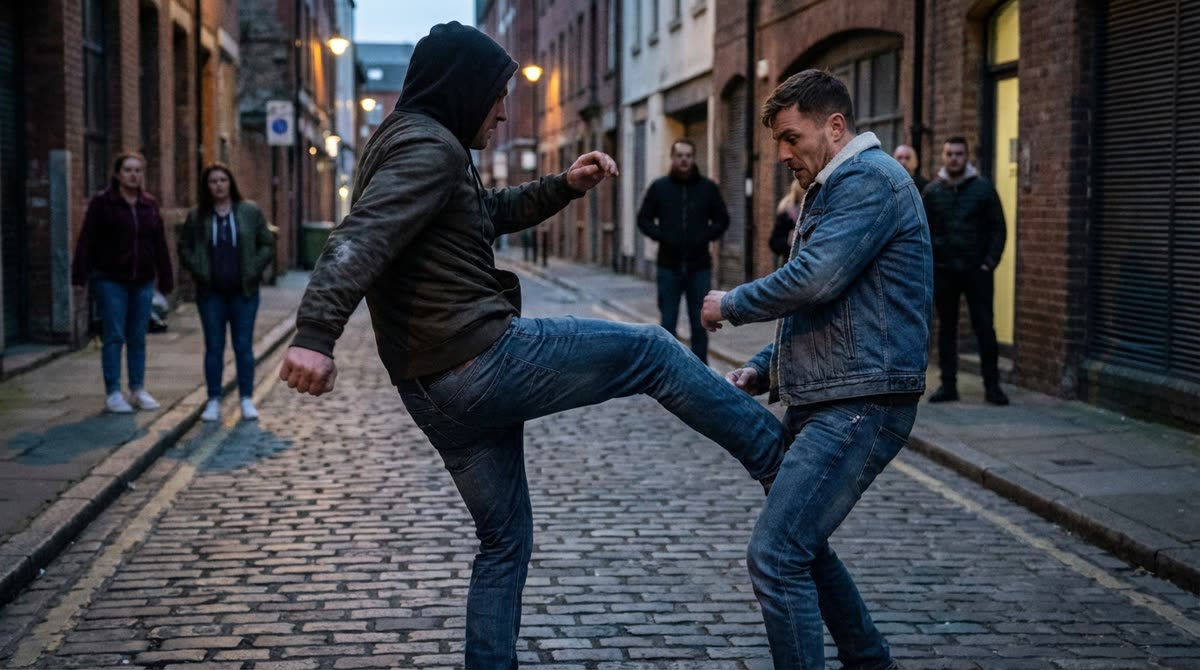
Here's what I mean. Soccer players, biggest babies in sports... even those guys take hard shots to the groin and they keep playing if they're motivated. If a professional athlete who flops when someone breathes on him can fight through a groin strike, what makes you think a guy trying to hurt you is going to fold?
He won't.
But here's where it gets worse. What I'm about to show you changes everything you thought you knew about defending yourself...
Table of Contents
- How I Learned This the Hard Way
- The Dangerous Lie Self-Defense Classes Teach
- Real Incidents Where Groin Kicks Failed
- Why Groin Kicks Fail When It Matters Most
- What Happens When Your "Go-To" Move Fails
- The One Target That Actually Stops Attackers
- Why Simple Beats Complex Every Time
- What You Should Actually Train
- Frequently Asked Questions
How I Learned This the Hard Way
I worked the door at a place called Kokomos for two years. Every night we'd have two or three fights a night, Thursday, Friday, Saturday, every week for two years. Real fights. Real violence. Guys who wanted to hurt you.
You know what I learned in those two years?
High kicks didn't work. Nothing above the waist was working with high kicks. Trying to grab punches as they're coming to lock an arm? Never happened. Never worked once.
What worked? Simple things. Punches that were straight. Blocks and covering that was on the inside. Gross motor movements you could do when your heart rate was through the roof and you couldn't think straight.
The schools that teach a woman who's 110 pounds or 130 pounds to just knee to the groin... that's not going to stop them. I don't think I've ever seen anybody with any level of toughness that's stopped because they took one.
Later, when I was working with the fight team at the unit, we tested everything. Including groin strikes.
My training partner Andrew put it even more bluntly. He's got over 20 years of BJJ experience, black belt, the whole deal. I asked him what happens if someone hits him in the groin during a fight.
If someone kicks me or hits me in the groin, that's just going to enrage me. And my response might be more violence.
Let that sink in. The technique that's supposed to save your life might actually make your attacker angrier. That's what I'm trying to get across here.
The Dangerous Lie Self-Defense Classes Teach
Walk into any self-defense seminar and you'll hear the same thing. "If someone grabs you, knee them in the groin." They make it sound so simple. So effective. So reliable.
And it is simple... in their nice, clean, air-conditioned training room with a cooperative partner who's expecting it and pulling their punches.
But that's not reality.
In reality, the guy attacking you isn't standing still. You're not calm and collected. Your hands are shaking. Your heart is pounding so hard you can hear it in your ears. Adrenaline has flooded your system and your fine motor skills have completely collapsed.
And the attacker? He's committed. He's aggressive. He's probably done this before. He might be high on something. He might have buddies watching. He might be so full of adrenaline that pain signals aren't even registering anymore.
This is the environment where your carefully practiced knee to the groin is supposed to work.
It won't.
But most people don't realize this until it's too late. Until they're in an actual situation and they try their "move" and it does absolutely nothing. And then what?
Real Incidents Where Groin Kicks Failed
You don't have to take my word for it. There are documented cases where groin strikes failed in actual attacks.
Case Study 1: California Assault (People v. Smith, 2003)
During a violent assault where a gun was involved, a young female victim attempted to kick her attacker in the groin. The kick missed. The gun discharged accidentally during the struggle. The attacker fled briefly but returned. The victim survived, but the groin kick... the technique she'd been taught would save her life... didn't land, didn't stop the attack, and didn't buy her time to escape.
Source: People v. Smith, California Supreme Court, 2003
Case Study 2: Martial Artist's Personal Account
A Jeet Kune Do practitioner with years of training described an incident where he instinctively split-kicked two friends during a tense moment. One kick landed precisely on the testicles. The victim collapsed in agony... and then got back up, enraged. He grabbed a pizza knife and chased the person who kicked him for nearly a minute. The pain didn't stop him. It escalated him.
The second kick missed entirely, hitting only the thigh.
Source: 6 Dragons Kung Fu Self-Defense Real Story
Case Study 3: Legal Record Assault
In another documented case, a victim attempted a groin kick during an assault. The attacker grabbed her leg mid-kick and struck her in the face. The attempt to use a groin strike left her vulnerable, off-balance, and open to a counter-attack.
Source: Legal Case Record, 654 So.2d 455
These aren't made-up scenarios. These are real incidents where real people tried the technique they were taught... and it failed.
Why Groin Kicks Fail When It Matters Most
Let me break down exactly why groin kicks are so unreliable. There are four major problems, and every one of them is backed by what I've seen in hundreds of real encounters and supported by actual research.

First, adrenaline overrides pain.
When someone is attacking you, their body dumps massive amounts of adrenaline into their system. That adrenaline suppresses pain signals through a phenomenon called stress-induced analgesia (SIA). This is documented in medical research. Studies show that acute stress temporarily reduces pain perception by releasing endogenous opioids and activating noradrenergic systems in the brain.
It's the same mechanism that lets soldiers keep fighting after getting shot. The same reason athletes finish games with broken bones.
Your attacker's brain is focused on one thing: hurting you. Pain in his groin? That's background noise.
Source: National Institutes of Health: Stress-Induced Analgesia Research
Second, your fine motor skills are gone.
At 145 beats per minute (which is exactly where you'll be in a real attack), your fine motor skills deteriorate dramatically. Precise targeting, like hitting a small moving target between someone's legs while they're grabbing you? Nearly impossible.
This is why special operations units train gross motor skills. Big, simple movements that work even when your body is in full panic mode.
Related: Why Special Forces Train Gross Motor Skills (And You Should Too)
Third, the distance and angle are never right.
In class, you practice on a partner standing at the perfect distance. In reality, you're being grabbed, pushed, pulled, twisted, slammed. The clean shot you practiced? It's not there.
And while you're trying to line up that perfect groin kick, he's hitting you in the face.
Fourth, even when it lands, it often doesn't work.
This is the part no one wants to talk about. Even a solid groin strike doesn't guarantee a stop. Pain tolerance varies wildly. Some people have naturally higher thresholds. Others are on drugs or alcohol that further dull pain response. And in the chaos of a real fight, with adrenaline flooding both bodies, a groin strike might cause discomfort or nausea... but not incapacitation.
According to self-defense researchers and anecdotal reports from martial artists who've tested this in live training, successful incapacitation from a groin strike happens about one-third of the time under controlled conditions. In real-world chaos? Even less.
Source: 6 Dragons Kung Fu: Why Groin Kicks Don't Work
What Happens When Your "Go-To" Move Fails
Picture this scenario with me.
You're walking to your car in a parking garage. It's evening. Most people have already gone home. You hear footsteps behind you, getting closer. You speed up. So do they.
Suddenly a hand grabs your shoulder and spins you around. A man you've never seen before is right in your face. He's bigger than you. Stronger than you. And he's got that look in his eyes that tells you this is really happening.
Your training kicks in. You throw your knee up toward his groin as hard as you can.
It connects.
And he doesn't stop.
Maybe you didn't hit him square. Maybe the adrenaline is blocking the pain. Maybe he's on something. It doesn't matter why. What matters is that your one technique, the move you've been taught will save you, just failed.
And now you're out of options. You used your element of surprise. You threw your best shot. And he's still standing there, except now he's angrier. His grip tightens. He shoves you toward the ground. Your head hits concrete.
This is what happens when we trust techniques that sound good in theory but fail under real stress. This is why I can't express to you enough how important it is to train what actually works.
Because in that parking garage, you don't get a second chance.
The One Target That Actually Stops Attackers
So if groin kicks don't work, what does?
The eyes.
I know that sounds simple. Maybe too simple. But here's the thing... the genius is in the simplicity. If it's complex, it's not going to work.
The eyes are the only organ in the human body that are directly wired to the brain. All of your other organs are wired through the spine. The reason is so that you can't fight through the pain.
This isn't theory. This is anatomy. When you apply pressure to someone's eyes, their body responds involuntarily. It doesn't matter how tough they are. It doesn't matter how motivated they are. It doesn't matter what drugs they're on.
Once I put pressure on his eyes with my thumbs or my fingers, he's not fighting through. His esophagus will start to close off, he'll panic, it'll release a lot of adrenaline, he'll breathe less, he'll almost be paralyzed, paralytic.
I've tested this with special forces guys who called bullshit on the technique. Guys with insane pain tolerance. We put pressure on their eyes and no one has ever been able to fight through it.
Zero people.
The principle is simple: where the thumbs go, his head and body will follow.
You don't need to be strong. You don't need years of training. You just need to reach his eyes.
This is what changes everything...
Ocular control is just one technique from my HAVOC system.
Inside HAVOC, you'll discover:
- The "thumb drive" technique I used to control attackers at Kokomos (works even if you're half his size)
- The 3 vulnerable targets that create involuntary shutdown responses
- How to finish a fight in 15 seconds using speed and aggression
- The exact gross motor skills used by special operations units
- Pre-attack indicators I learned in hundreds of real encounters (you'll see violence coming before it happens)
- My "Anatomy of Violence" method that strips away everything that doesn't work under real stress
No belt rankings. No years of training. Just what works when your life depends on it.
Over 47,000 people have already learned the system. See what's inside HAVOC →
Why Simple Beats Complex Every Time
Groin kicks are just one example of a much bigger problem in self-defense training. Most programs teach techniques that are too damn complex to execute when your life's on the line.
Here's what I learned working with some of the most elite fighters in the world at the unit: the genius is in the simplicity. If it's complex, it's not going to work.
We teach simple, brutal, gross motor movements that work when your heart rate is 180 and your thinking brain has shut down completely.
Simple. Direct. Gross motor.
Think about it this way: if a technique requires precise targeting, specific distance, perfect timing, and a cooperative attacker to work, it's not self-defense. It's choreography.
What You Should Actually Train
Train gross motor skills, better than fine motor skills.
Large, powerful movements that work even when adrenaline has destroyed your coordination.

Target what can't be fought through.
The eyes, the throat, the base of the skull. These create involuntary responses that override pain tolerance and willpower.
Related: Is Martial Arts Effective in a Real Fight? The Truth From 500+ Street Encounters
Train speed and aggression.
A real fight needs to end in 15 to 30 seconds. I can't express to you the importance enough of finishing the fight in that window. Beyond that, it becomes about who is more fit, who is stronger, who has backup arriving.
Keep it simple.
If you can't do it when you're terrified and exhausted, it's useless.
Related: What to Do If Someone Attacks You: 7 Steps That Save Lives
Train situational awareness FIRST.
The best fight is the one you never have. Learn to see violence coming before it arrives. Pre-attack indicators, de-escalation, managing distance... these skills prevent more attacks than any technique ever will.
Related: How to Tell If Someone Is Going to Attack You:
EXPERT VERDICT
Bottom line from hundreds of real encounters: Groin kicks fail because adrenaline overrides pain response. The most effective immediate self-defense target is the eyes. Direct pressure to the eyes triggers an involuntary neurological shutdown that cannot be overcome through willpower, drugs, or pain tolerance. This is basic anatomy, not theory.
Frequently Asked Questions
Do groin kicks actually stop attackers?
Rarely, and here's why. I've seen this play out hundreds of times. Soccer players, biggest babies in sports, even those guys take hard shots to the groin and keep playing if they're motivated. Adrenaline suppresses pain signals through a documented phenomenon called stress-induced analgesia. What feels devastating in practice does almost nothing in a real attack when both parties are flooded with adrenaline and aggression.
What is more effective than a groin kick for self-defense?
The eyes. Hands down. The eyes are the only organ in the human body that are directly wired to the brain. When you apply pressure to someone's eyes, they can't fight through it. I've tested this with special forces guys who called bullshit on it, and no one has ever been able to fight through eye pressure. It creates an involuntary neurological response that overrides pain tolerance, drugs, and motivation.
Why do self-defense classes still teach groin kicks?
Because they look good in class. They're easy to demonstrate. And on a compliant training partner who's expecting it, they do work. But real violence is completely different from classroom practice. Most instructors have never been in a real fight. They teach what they were taught, not what actually works under stress.
What is ocular control in self-defense?
Ocular control is the technique of applying direct pressure to an attacker's eyes. Once I put pressure on his eyes with my thumbs or my fingers, he's not fighting through. His body triggers an involuntary panic response... his esophagus closes, his breathing becomes restricted, and he becomes nearly paralytic. Where the thumbs go, his head and body will follow. It's that simple.
How long does a real street fight last?
Most real violent encounters last 15 to 30 seconds. Beyond that, it becomes about who is more fit, who is stronger, who has backup arriving. This is why self-defense has to focus on overwhelming aggression and techniques that work immediately. You don't have time for complex combinations or waiting for the "perfect moment." You need simple, brutal, gross motor skills that end the threat in that 15 to 30 second window.
Can a small person defend themselves against a larger attacker?
Yes, but only if you're targeting the right things. Size and strength don't matter when you're going after the eyes, throat, or base of the skull. That's why HAVOC focuses on gross motor skills and vulnerable targets instead of trying to out-muscle someone bigger than you. A 110-pound woman can apply the same pressure to an attacker's eyes as a 200-pound man. Anatomy is the great equalizer.
What about groin strikes in sports or MMA?
Even in professional MMA, groin strikes are often ineffective. Fighters wear cups, but more importantly, they're already in a high-adrenaline state. There have been multiple documented cases in UFC fights where a fighter took an accidental groin strike, grimaced, took the 5-minute recovery time, and then came back and finished the fight normally. If trained fighters with protective gear still can't be reliably stopped by groin strikes, what makes you think it will work on a motivated attacker on the street?
Are there any situations where a groin kick might work?
The only time a groin strike has a decent chance of working is if: (1) you have a clean, unobstructed target, (2) the attacker is not yet fully committed or adrenalized, (3) you follow it immediately with other strikes to more reliable targets like eyes or throat, and (4) you use it as part of a combination, not as your primary technique. But even then, you're better off targeting the eyes first. Why risk your safety on a low-percentage technique when a higher-percentage option is available?
About the Author
Adam Seegmiller is a Special Forces and Close Protection Operator who served in a Tier 1 unit, with over 24 years of military experience and hundreds of documented real-world confrontations. He is the creator of the HAVOC self-defense system and founder of Centerline Tactical, which has trained over 47,000 students worldwide.
Ready to Learn What Actually Works?
HAVOC is Adam Seegmiller's complete self-defense system... 30 modules of techniques proven in hundreds of real confrontations. No belts. No years of training. Just what works when your life depends on it.
Over 47,000 people have already made the switch. Join them.