

Best Martial Art for Street Fighting? Wrong Question.
I spent decades training in traditional martial arts. Competed at the state level in Taekwondo. Worked as a bouncer in the roughest bars I could find for years. Deployed for five cumulative years in combat zones across Iraq, Afghanistan, Europe, Africa, and the Middle East. Served on the fight team in a Special Forces and Close Protection Operator who served in a Tier 1 unit.
Hundreds of real encounters later... bar fights, street violence, close protection work, combat operations... I can tell you something that might surprise you:
There is no "best" martial art for street fighting.
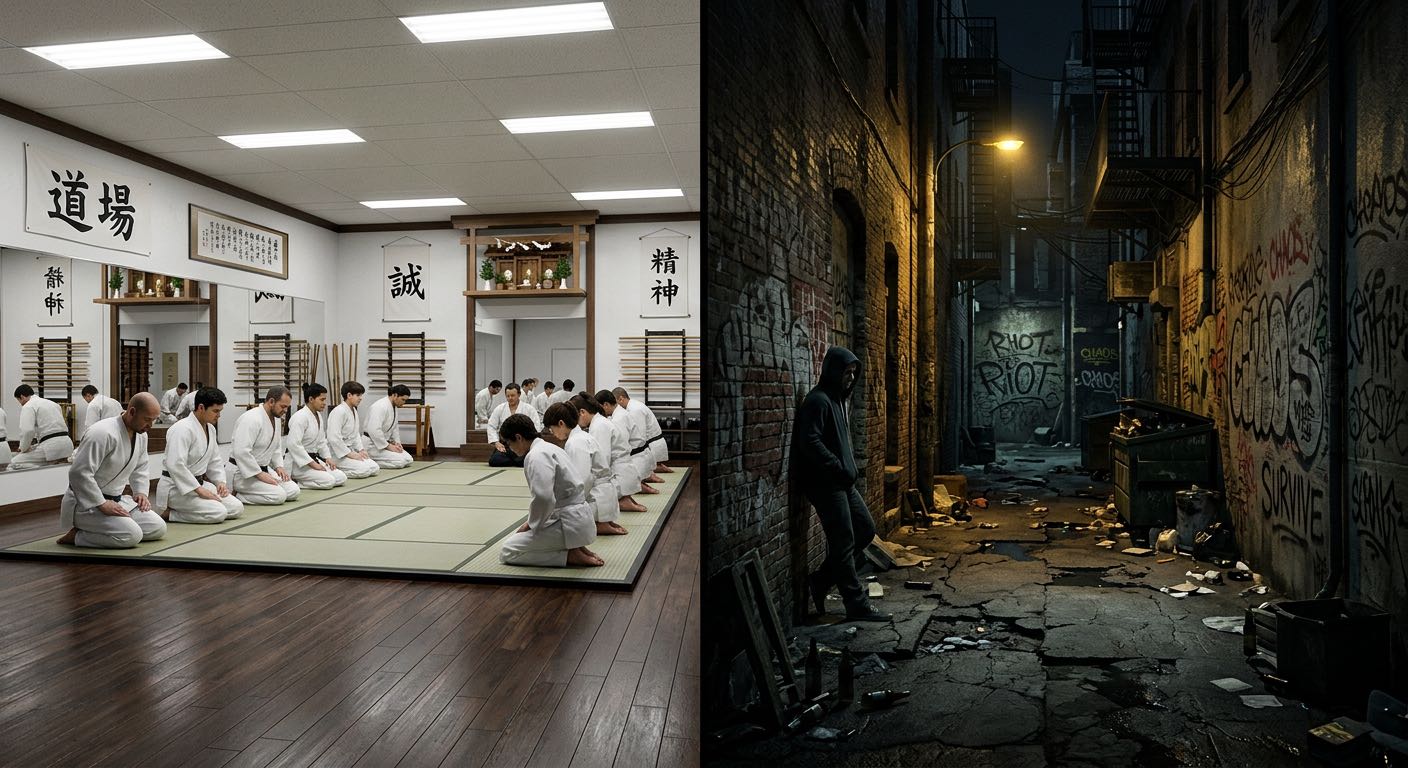
What works in real violence is a framework built on three principles: gross motor skills, vulnerable-area targeting, and ending the fight in under 15 seconds. Everything else is window dressing that collapses under stress.
When the Dojo Meets Reality: Stories You Won't Hear in Class
In 2024, a Reddit user with 14 years of karate training (dan-graded, equivalent to black belt level) shared what happened when a knife was put to his throat after work. He froze completely. Couldn't react. Couldn't move. Despite years of training in defense techniques, the shock of real violence shut him down entirely. The incident destroyed his confidence so badly he quit training altogether.
Another account from 2023: A 33-year-old man with martial arts experience was lured into an alley robbery. Attackers applied a rear naked choke, took him down, and threatened him with a weapon. He dissociated from the panic, froze, and handed over everything. Later he wrote: "My training failed me."
These aren't isolated incidents. When I started working as a bouncer after years of competition martial arts, I learned the same lesson the hard way. Most of what I thought would work... didn't. Drug dealers, criminals, people high on substances... they don't fight like sparring partners. They don't follow the rules. And when your heart rate spikes past 145 beats per minute, all those complex combinations you drilled a thousand times? Gone.
I'd always have a sensei teach these 7, 10, 12 movement techniques. And in my head I'm like, what was number seven? Then I watched my instructor sparring. He wasn't doing any of that. Two, three movements and out.
Combat stress research from law enforcement and military studies confirms what I learned in bars and combat zones: when your heart rate exceeds 145 BPM, fine motor skills fail. Vision narrows to less than 30 degrees. Complex decision-making shuts down. Your body reverts to whatever has been drilled into muscle memory under stress... or it freezes.
The Commercial Dilution Problem Nobody Talks About
Modern martial arts schools are businesses first, combat systems second. And that changes everything.
Walk into most traditional martial art dojos and ask the instructor: "How long will it take me before I can defend myself?" You're not going to get a straight answer. The reason? If they taught you everything effective in the first couple of months, they'd lose their business in a year. So they trickle content. They add complexity. They turn what should be simple into something that takes years to master.
Traditional martial arts are by design engineered to take your money. They're becoming watered down versions of what they used to be. The instructors have to spread it out over years so they can milk you for as much money as long as possible.
I'm not saying martial arts have zero value. They build fitness. They build discipline. They build confidence. But there's a massive difference between learning a sport and preparing for real violence. And most schools blur that line because the truth doesn't sell memberships.
When I competed in Taekwondo at the state level, I was good. Fast. Technical. But when I tried those high kicks in a real bar fight? I got put on my ass. The tile floor, the adrenaline, the chaos of an actual attack... nothing like the dojo. I tried it again later in the Army with some tough guys, goofing around. Got put on my ass again. That's when I stopped believing in techniques that look impressive and started asking: what actually works when everything goes wrong?
What Operators Actually Train (And Why It's Different)
In special operations, we had a problem: we needed guys with minimal martial arts experience to be effective in hand-to-hand combat, fast. We didn't have years to turn them into black belts. Many times, firearms weren't an option based on the mission or the environment. We needed something that worked under extreme stress, was easy to teach, and didn't require years of refinement.
The solution? Radical simplicity.
We built a system around three non-negotiable principles:
Principle 1: Gross Motor Skills Only
Under stress, your body can push, pull, and strike with large muscle groups. That's it. Fancy wrist locks? Gone. Spinning kicks? Impossible. Complex combinations? Your brain can't process them at 175 BPM.
What works:
- Palm strikes to the face
- Hammer fists to vulnerable areas
- Elbow strikes in close quarters
- Knee strikes to the body and head
These movements work because they align with how your body naturally responds to a startle response. Numerous studies on law enforcement defensive tactics show that when officers are startled, they instinctively square off to the threat. We built our entire striking platform around that natural reaction instead of trying to override it with techniques that sound good in theory.
Principle 2: Target Vulnerable Areas
Size and strength matter less when you target areas that don't care about muscle mass:
- Eyes (directly wired to the brain, cause paralytic panic response)
- Throat (collapses airway, triggers survival instinct)
- Base of skull (neurological shutdown)
- Knees (structural failure regardless of size)
In special operations, we spent five days on a course dedicated entirely to eye attacks. Not because they're complicated... because they're devastatingly effective and people hesitate to use them. The eyes are the only organ in the human body directly wired to the brain. All your other organs route through the spine. You can't fight through eye pain. Your esophagus closes, you panic, you release adrenaline, and your body becomes nearly paralytic. I've applied this on some of the toughest special forces guys I know. No one fights through it.
Principle 3: End It in Under 15 Seconds
According to FBI Uniform Crime Reporting data, most violent assaults are over in seconds. The longer a fight goes, the more variables stack against you: exhaustion, bystanders, weapons, the other guy's friends showing up, legal consequences.
Beyond 30 seconds, the fight becomes about who's fitter, who's stronger, maybe who's on drugs. That's not a game you want to play. Speed and aggression matter more than technique. Overwhelm your opponent's decision-making loop before they can process what's happening.
The genius is in the simplicity. If it's complex, it's not going to work. We had to find things that were overwhelming to the enemy, that were easy to manufacture and recreate under stress.
Why BJJ, Boxing, and MMA Fall Short (And Where They Shine)
Let me be clear: Brazilian Jiu-Jitsu is an incredible art. Boxing builds hand speed and power better than almost anything. MMA fighters are legitimate athletes with real fighting skills.
But each has limitations in the context of street violence:
BJJ: The Ground Game Problem
BJJ teaches world-class ground control. In a controlled environment with mats and a referee, it's unmatched. On the street? Going to the ground is dangerous. Glass. Rocks. Curbs. Concrete. And the guy you're fighting might have friends. Even Andrew McDonald, my Ground Zero co-instructor and third-degree BJJ black belt, doesn't advocate taking street fights to the ground.
That doesn't mean BJJ is useless. If you end up on the ground, you better know how to fight there. But it shouldn't be your strategy. It should be your backup plan.
Boxing: The Ruleset Gap
Boxing builds incredible punching power, footwork, and timing. Those are all valuable. But boxing has rules. No kicks. No elbows. No eye gouges. No groin strikes. No weapons. In a bar or a parking lot, none of those rules exist.
Boxing gives you a strong foundation. But it's incomplete by itself for self-defense.
MMA: Close, But Not Designed for Violence
MMA is the closest combat sport to real fighting. It combines striking, grappling, and ground work. Fighters train under pressure. They test their skills live.
But even MMA operates under constraints: weight classes, rounds, a referee who stops the fight if it gets too dangerous, rules against eye gouges and groin strikes. Real violence has none of that. And as the Reddit stories show, even trained fighters can freeze when surprised or outnumbered.
A 2019 incident involving UFC Hall of Famer BJ Penn illustrates the gap. Outside a Hawaii bar, Penn (one of the greatest fighters in MMA history) was knocked down by a local who likely had zero formal training. Penn recovered and dominated, but the initial shock and chaos of the real-world encounter threw him off. Even elite fighters are vulnerable to surprise, alcohol, distraction, or underestimating a street tough.
The Missing Piece: Stress Inoculation
What most martial arts lack is training under the physiological conditions of real violence. If you've never trained with your heart rate above 145 BPM, you don't know what you'll do when it matters. Sparring is valuable. But sparring where you can tap out or the coach stops it when things get dangerous is fundamentally different from a situation where stopping means serious injury.
That's why law enforcement and military defensive tactics programs emphasize scenario-based training with role players, protective gear, and stressors like loud noises, strobe lights, and physical exhaustion. They're trying to replicate the chaos your body will experience in a real encounter.
The Krav Maga Trap (And What Happened to It)
Krav Maga used to be the answer. Israeli Defense Forces combatives. Raw, brutal, effective. Built for soldiers who needed to survive.

Then it got commercialized. Walk into most Krav Maga schools today in strip malls across America, and you're learning a watered-down version that's been sanitized for liability and stretched out over months so they can collect tuition. The original IDF system taught you to defend yourself in weeks. The modern version? You'll be learning choreographed defenses for months before they trust you with the real material.
Krav Maga used to be awesome. What's out there today in strip malls doesn't resemble what the IDF delivered. It's commercialized, takes months before you learn to defend yourself.
This isn't unique to Krav Maga. Almost every martial art that transitions from military/police use to civilian business gets diluted. The market demands it. Parents don't want their kids learning how to gouge eyes. Insurance companies don't want liability. And business owners need students to stick around for years.
The Framework That Actually Works
So if traditional martial arts are diluted, combat sports have rulesets, and Krav Maga got commercialized... what's left?
A principle-based framework that adapts to the chaos of real violence:
Awareness First, Fighting Last
The best fight is the one you never have. Awareness isn't just scanning your environment. It's understanding predatory behavior, recognizing pre-attack indicators, controlling distance, and positioning yourself so violence is difficult to initiate against you.
I call it omni-awareness instead of situational awareness. It's ever-present. You're not paranoid. You're just switched on. One technique I teach: scan right to left instead of left to right. We all read from left to right, so our brains auto-pilot through left-to-right scans. Scanning the opposite direction forces your brain to slow down and pick up details you would've missed. That's standard in most special operations units.
For more on recognizing an attack before it happens, see: How to Tell If Someone Is Going to Attack You
Simplicity Under Stress
When violence happens, you need techniques that work at 175 BPM with tunnel vision and no time to think. That means:
- One defensive movement that covers everything (we call it "caging")
- Strikes to targets that don't require precision (eyes, throat, ears)
- No complex combinations or sequences
- Aggression and speed over technique
Andrew McDonald, my co-instructor with over 30 years of martial arts experience, agreed with me when we built this system: traditional blocks take at least six months to master if you train six hours a day. Who has that time? And even then, most instructors don't use them when they actually spar.
Train What You'll Actually Use
We only teach techniques that have been tested in real-world violence. Not theory. Not "this should work." Techniques that have been used in special operations, law enforcement, close protection, and real street encounters. And we drill them under stress... elevated heart rate, multiple attackers, confined spaces, low light.
Let's teach what we use. Let's teach something brutal, effective, simplistic, and easily repeated under stress that doesn't take years and years of training.
End It Fast
Every technique, every tactic, every principle serves one goal: ending the threat in under 15 seconds. That's the window where you have maximum effectiveness before exhaustion, bystanders, or additional threats complicate everything.
For practical steps on what to do when an attack happens, see: What to Do If Someone Attacks You
The Uncomfortable Truth About "Proven" Techniques
Here's something most instructors won't tell you: many techniques taught in martial arts schools don't work in real violence.
Groin kicks? Soccer players (some of the biggest babies in sports) take hard shots to the groin and keep playing if they're motivated. I've never seen anyone with any level of toughness stopped by a single groin strike. It might enrage them. It might make them more violent. But it rarely ends a fight. (For more on this, see: Why Groin Kicks Don't Work in Real Fights)
High kicks? I fought at a fairly high level in Taekwondo. The only time I tried a high kick in a real bar fight, I got put on my ass. Wet floors, confined spaces, adrenaline, uneven surfaces... high kicks are a recipe for disaster in the real world. The only kick we teach is a knee strike. Below the waist. Simple. Devastating.
Traditional blocks? Andrew has never had someone successfully use a traditional martial arts block on him in a real encounter. They're too slow, too complex, and require too much precision under stress.
Why Most Martial Arts Training Fails in Street Fights
The gap between dojo training and real violence comes down to a few critical factors:
1. No Surprise Element
In class, you know when the attack is coming. Your partner bows. You both get into stance. Maybe the instructor says "go." Real attacks don't work that way. You're mid-conversation. You're looking at your phone. You're getting out of your car. The attack is already in motion before your brain registers threat.
I've been knocked out many times... falling out of helicopters, fighting in cages with MMA fighters, street encounters. The times I got knocked out weren't from the hardest shots. They were from shots I didn't see coming. If you don't see the blow, your brain has less ability to absorb it. The chin acts as a lever that's not connected to the skull, causing higher torque and rotation. That's why sucker punches are so dangerous.
2. No Real Consequences
When you spar, the worst that happens is you tap out or your coach stops it. When you compete, you might lose a match. In real violence, the consequences are injury, permanent disability, or death. That psychological weight changes everything. Many trained martial artists freeze when the stakes become real, as we saw in the Reddit accounts earlier.
3. Controlled Environment
Dojos have mats, good lighting, space to move, and rules. Streets have broken glass, parked cars, bystanders, uneven surfaces, and no rules. The guy attacking you might be on drugs. He might have a weapon you haven't seen yet. His friends might be circling around. Techniques that work in a gym often fail when you add chaos.
4. Time to Master Complexity
Most martial arts require years to reach basic proficiency. That's fine if your goal is sport competition or personal development. But if your goal is self-defense, spending three years to learn how to defend yourself is absurd. You need something effective NOW.
What Research Actually Says
Studies on law enforcement use of force show that officers (many with martial arts training) rarely use the complex techniques they learned. Under stress, they default to gross motor movements: pushing, striking with fists, tackling. The body reverts to what's simple and instinctive.

Research on combat sports effectiveness in street encounters is limited because real-world violence doesn't happen in controlled studies. But anecdotal evidence from law enforcement after-action reports, military combatives reviews, and security professionals consistently points to the same conclusion: simple, aggressive, gross motor techniques outperform complex martial arts in chaotic environments.
For a deeper analysis of whether martial arts training translates to real fights, see: Is Martial Arts Effective in a Real Fight?
Expert Verdict
The bottom line: The "best martial art for street fighting" isn't a martial art at all. Real violence is over in seconds under extreme stress. What works is gross motor skills, vulnerable-area targeting, and speed. Operators train brutal simplicity that works at 175 BPM. Traditional martial arts build fitness and discipline but are often too complex and diluted to be reliable in chaos. Combat sports like MMA, BJJ, and boxing provide valuable skills but operate under rules that don't exist on the street. The most effective approach combines awareness (to avoid the fight), stress-inoculated training, and a handful of gross motor techniques targeting vulnerable areas.
Frequently Asked Questions
Is BJJ good for street fighting?
BJJ teaches excellent ground control and is valuable if you end up on the ground. But intentionally taking a street fight to the ground is dangerous. Glass, concrete, multiple attackers, and weapons make the ground the last place you want to be. Learn BJJ as a backup, not a primary strategy.
Is boxing the best for self-defense?
Boxing builds great hand speed, power, and timing. But it doesn't address weapons, multiple attackers, or pre-attack awareness. It's a strong foundation but incomplete alone. You also need to understand distance management, threat recognition, and what to do when boxing rules don't apply.
Is Krav Maga effective?
Original Israeli Defense Forces Krav Maga was highly effective. Most commercial schools today teach a watered-down version that's been stretched over months for business reasons. If you find a legit instructor with military or law enforcement background, it can be valuable. Most strip mall Krav Maga schools don't meet that standard.
What do Special Forces use for hand-to-hand combat?
Integrated combatives built on gross motor skills, vulnerable-area targeting, and stress-inoculated training. The focus is overwhelm the opponent fast with simple, brutal techniques that don't require years to master. Each unit has variations, but the core principles remain: simplicity, aggression, and speed.
How long does it take to learn effective self-defense?
With the right system, you can learn effective techniques in weeks. Traditional martial arts stretch it over years because their business model requires it. The difference is focus: are you learning a sport/art, or are you learning to survive violence? Those are two different goals requiring two different timelines.
Can a smaller person defend against a larger attacker?
Yes, by targeting vulnerable areas that size doesn't protect: eyes, throat, base of skull, knees. A 110-pound person applying pressure to a 250-pound attacker's eyes will get the same result as if they were the same size. Vulnerable-area targeting equalizes the size and strength gap.
Should I train MMA for street fighting?
MMA builds excellent overall fighting ability, conditioning, and mental toughness. It's one of the best bases you can have. But supplement it with awareness training, understanding of weapons and multiple attackers, and techniques that aren't allowed in the cage (eye gouges, throat strikes, groin attacks). MMA gives you the engine. You need to add the tools for chaos.
What's the fastest martial art to learn?
Systems focused on gross motor skills and vulnerable-area targeting are fastest to learn because they work with your body's natural stress response instead of trying to override it. Complex martial arts requiring fine motor precision take years. Simple, brutal systems can be functional in weeks with proper instruction and stress-inoculated practice.
About the Author
Adam Seegmiller is a Special Forces and Close Protection Operator who served in a Tier 1 unit, with 24+ years in real-world violence spanning combat zones, close protection operations, and hundreds of street encounters. He created HAVOC: Direct Action Defense System to teach civilians the same operator principles developed for special operations forces. Over 47,000 students have trained with Centerline Tactical.
Ready to Learn What Actually Works?
Stop wasting years on techniques that fail under stress. Over 47,000 people have made the switch to operator-level training that works in the real world. Get HAVOC now and learn what special operations forces use when firearms aren't an option.